
Pest Management Consulting and Training
IPM programme setup, audit preparation, staff training and independent third-eye inspection: pest management consulting for businesses.
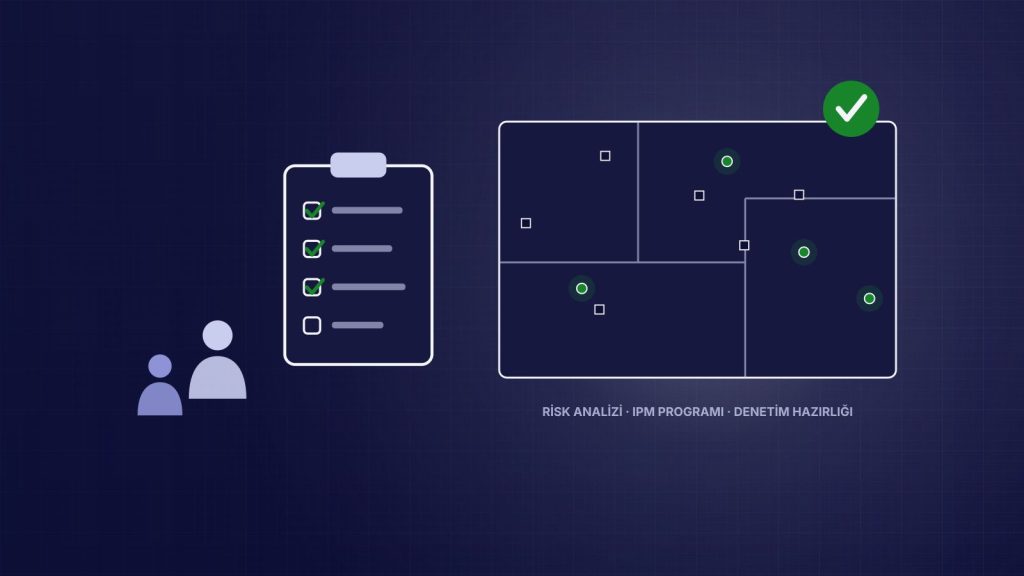
Definition
Consulting helps businesses set up a pest management programme, assess their current programme and prepare for audits. From an independent viewpoint it shows gaps and areas for improvement.
The service covers programme design, site assessment, training and independent inspection.
Scope
- Pest management programme design and review
- Audit and customer-specification preparation
- Assessment of the current provider's programme
- Staff briefing and training
- Independent (third-eye) site inspection
General method
Treatment follows the principle of prevention and monitoring first, with targeted intervention where needed. Product and method are chosen after the survey according to the target, the sensitivity of the site and legal requirements.
Product names, doses and licence details are not given on this page; they appear in the treatment plan and under the relevant product conditions.
Application areas
- Food production and processing plants
- Warehouses and logistics
- Hotel and restaurant groups
- Pharmaceutical and cosmetics facilities
Target pests
- Rodents
- Flying and crawling insects
- Stored-product pests
Process steps
- Initial inspection Entry routes, hiding places, moisture, waste, human traffic and product movement are assessed together.
- Risk and target analysis The target pest, the source of infestation and repeat-risk points are identified.
- Programme and method selection A treatment and monitoring programme suited to the sensitivity of the site and to legal requirements is written.
- Treatment Treatment is carried out by authorised personnel with products and methods in line with the plan.
- Monitoring Monitor, station and observation data are collected at regular intervals.
- Reporting Findings, trends and recommendations are turned into a written report and stored in the PMDP.
- Review The programme is updated according to results; preventive measures are proposed for repeat points.
Documents and reporting (PMDP)
- Visit report: date, areas inspected, findings and action taken.
- Monitor and station records with activity observations.
- Trend and repeat-point analysis; corrective and preventive recommendations.
- Photographic site notes and a mapped equipment layout.
- All records kept digitally in the PMDP and an archive ready for audits.
Preparation and safety
- Treatment hours are planned around how the site is used; out-of-hours work is possible.
- Access and covering arrangements for sensitive goods such as food, medicines, cosmetics and equipment are agreed beforehand.
- After treatment, users are informed (contact time, ventilation, when the area can be used again).
- Product and method selection takes account of worker health and environmental safety according to site sensitivity.
- To reduce repeat risk, improvements are proposed at points such as door thresholds, drains, behind shelving and loading lines.
Training and third-eye inspection
Training gives staff the knowledge to recognise pest signs, report findings and follow hygiene rules. A third-eye inspection reviews site and records with an independent eye and exposes gaps in the programme.
Training content and length are set according to need; the exact scope appears in the quote.
Audit readiness checklist
These are the areas where third-party food, pharma and automotive audits most often raise findings. Threshold values in the list are the company's field standards; criteria specific to your site are settled at the survey.
- Door and dock thresholds Is light visible at the floor joint? Gaps larger than roughly half a centimetre allow rodent passage; close them with rubber barriers or steel-bristle brushes.
- Windows and insect screens Fine-mesh screens on production and storage windows; no tears, holes or frame slippage.
- Cable, pipe and ventilation penetrations Gaps are closed with steel wool combined with polyurethane foam; rodents can gnaw plain foam.
- Drains Non-return or locked strainers on indoor drains; fine-mesh protection at outdoor drain outlets.
- Outdoor stations Fixed, locked, permanently numbered stations that match the site map exactly; damp and mould checks on bait stations.
- Flying insect devices Devices not visible from outside, not facing doors, not hung above production lines and mounted at a suitable flight height; lamp replacement and species-level counts on glue boards.
- Indoor monitoring and stacking Non-toxic glue or pheromone monitoring indoors; pallets stacked at least 50 cm from walls with the sanitary strip kept clear.
- Social areas and waste yard Lockers, canteen, kitchen and waste containers are checked regularly; lids closed, floors washed routinely.
- Records Trend charts for the last 12 months, CAPA opened for months with increases, current authorisation documents, folder of product labels and safety data sheets.
Corrective and preventive action (CAPA) flow
When a non-conformity or risky finding is detected, it is not closed by a note saying "checked"; a recorded corrective-preventive flow is run. The source may be a routine check, a QR scan or an audit.
- Detection and classification The finding is recorded with area and date and classified by risk level.
- Root cause analysis The "why" question is asked several times to reach a structural cause (5-whys method).
- Interim containment Risk is limited with an extra monitor or temporary sealing until the permanent fix arrives.
- Permanent corrective action An improvement with a named owner and deadline is made (e.g. replacing a worn door seal).
- Preventive action A procedural change prevents recurrence (e.g. adding a check item to the periodic maintenance list).
- Field verification and closure The fix is verified on site and the form is closed with approval from both sides.
Escort personnel and site safety training
The role of staff who accompany the applicator on site is important for the safety of the service. A training of about one hour and an assessment form are used for this purpose.
- Biocidal product groups used in pest control and target pests
- Product labels, pictograms and introduction to application equipment
- Acute and chronic poisoning risks and the first-aid approach
- Zoonotic risks transmitted by rodents and safe behaviour when dead rodents or droppings are found
- Basic rules such as not moving stations and not applying gel to food or contact surfaces
- Site-level reflections of quality, environmental and occupational safety management systems (application form, waste handling, protective equipment)
- Record kept through an attendance form and question-and-answer assessment
Frequently asked questions
What does consulting cover?
Programme design, site assessment, audit preparation, training and independent inspection.
What is a third-eye inspection?
An independent specialist reviews the site and records, separate from the current service provider.
Who is the training for?
Business staff and managers; content and duration are set according to need.
How is audit preparation done?
Existing records, maps and programme are reviewed; gaps and improvement proposals are reported.
Can I get consulting while working with another provider?
Yes; consulting can be provided independently.
Is a report provided after consulting?
Yes; findings, recommendations and priorities are delivered as a written report.
When is a CAPA opened?
It is opened when a trend rises, a structural gap is found or an audit finding arises. A root cause is sought, interim and permanent measures are recorded with owner and deadline and the CAPA is closed after field verification.