
Lesser grain borer: signs, risks and control approach
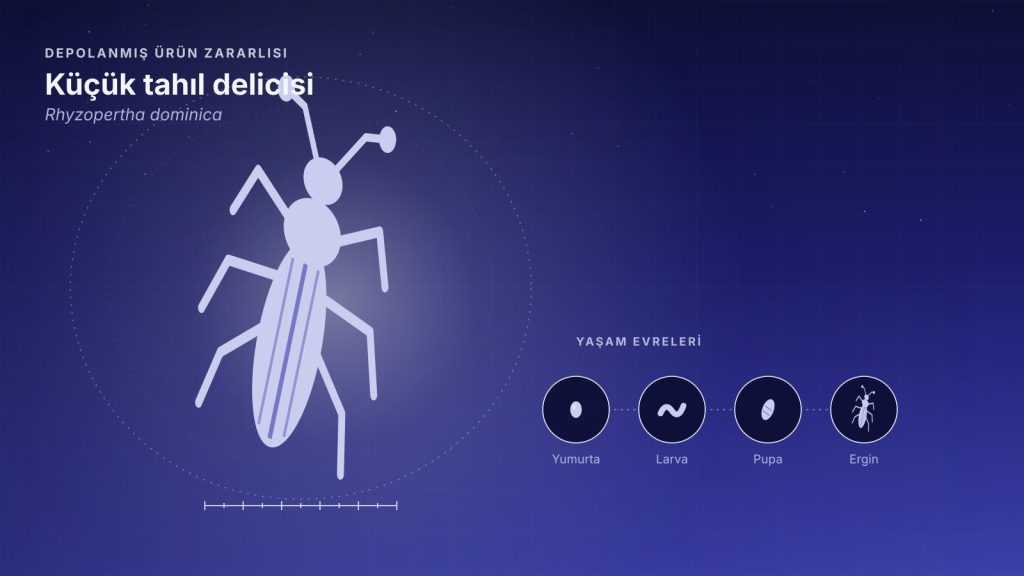
Stored-product pestRhyzopertha dominica
At a glance
Lesser grain borer (Rhyzopertha dominica) is a stored-product pest.
This page is general information; a site inspection and expert assessment are needed for your facility.
How to identify it
- 2–3 mm, dark brown and cylindrical; head hidden beneath the pronotum when viewed from above.
- Winged and a good flier; gnaws product.
- Larvae and adults feed in and on kernels.
Signs on site
- Holed kernels, flour-like dust and dusty floors
- Heating and bad odour
- Heavy flour-like dust in silos
Life cycle and growth
Both larvae and adults eat grain; multiplies quickly in warm conditions. A resilient and common pest.
Timings vary with temperature and humidity; rely on your own monitoring data rather than fixed numbers.
Risk table
- Grain loss: Heavy weight loss and powdering.
- Structural: Damage to wooden packaging and pallets.
- Spread: Can fly to new stores.
Sectors where it is common
Related sector pages:
- Grain and agriculture → /en/sectors/grain-agriculture/
- Food production → /en/sectors/food-production/
- Logistics and warehousing → /en/sectors/logistics-warehousing/
- Ports and maritime → /en/sectors/ports-maritime/
IPM approach
IPM combines monitoring, source removal, exclusion and targeted intervention instead of relying on a single treatment.
Fumigation is carried out only by licensed, authorised operators in line with regulations and product labels, with entry restrictions, gas monitoring and ventilation clearance.
- Post-harvest cleaning and cooling.
- Pheromone and trap flight monitoring.
- Inspect wooden pallets and packaging.
- Authorised fumigation at threshold.
Prevention checklist
- Check entry points regularly: door gaps, pipe and cable penetrations, ventilation.
- Keep food, waste and moisture sources closed and clean.
- Apply goods-in checks to incoming product, packaging and pallets.
- Record findings with dates using stations or monitors.
- Teach staff how to report a sighting and whom to call.
Records and audits
Audits and customer reviews expect finding date and place, action taken, product or method used, responsible person and closure evidence.
Pak İş keeps these in service reports and the PMDP customer portal; audit results still depend on the site system and certification body, and no guarantee is given.
When to call an expert
When monitoring thresholds are exceeded, live pests are found in product or sensitive areas, complaints recur, or a documented programme is needed before an audit.
Frequently asked questions
Why powdering?
Larvae and adults gnaw kernels into dust.
Does it affect wood?
It can also damage wood and packaging.
Is the result guaranteed?
No. This page does not promise outcomes; the approach depends on site conditions, entry points and hygiene practices.