
German cockroach: signs, risks and control approach
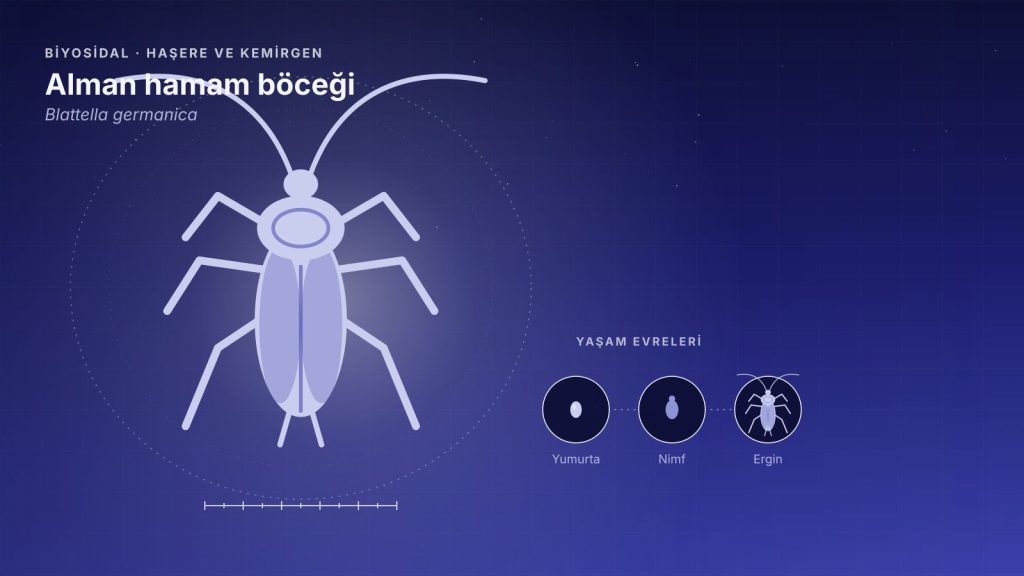
Biocidal (pests / rodents)Blattella germanica
At a glance
German cockroach (Blattella germanica) is a common pest handled under biocidal pest control. Small, fast-breeding cockroach that dominates kitchens, canteens and food plants.
This page is general information; a site inspection and expert assessment are needed for your facility.
How to identify it
- Two parallel dark stripes behind the head (pronotum) are the quickest way to tell it from other cockroaches.
- Adults are about 12–15 mm and light brown; they have wings but rarely fly.
- Females carry the egg case until just before hatching.
Signs on site
- Scattering insects when lights are switched on, many nymphs on sticky monitors
- Pepper-like droppings in hinges, frames and equipment
- Empty egg cases and a typical oily odour in heavy infestations
Life cycle and growth
Each egg case holds roughly 30–40 eggs and nymphs moult several times before becoming adults. Warmth, moisture and food let generations overlap, so a small finding can become a large population quickly.
Timings vary with temperature and humidity; rely on your own monitoring data rather than fixed numbers.
Risk table
- Food safety: Can carry microorganisms between waste, drains and food.
- Audits: Crawling-pest findings lead to non-conformities in BRCGS, IFS and HACCP audits.
- Commercial: Complaints, blocked product and reputational damage.
Sectors where it is common
Related sector pages:
- Food production → /en/sectors/food-production/
- Hotels and HORECA → /en/sectors/hotels-horeca/
- Hospitals and healthcare → /en/sectors/hospitals-healthcare/
- Retail and malls → /en/sectors/retail-malls/
IPM approach
IPM combines monitoring, source removal, exclusion and targeted intervention instead of relying on a single treatment.
Biocidal products are applied only as licensed products by authorised applicators in line with labels and regulations.
- Map activity with sticky monitors; hot spots are heat sources, behind cookers and wash-up areas.
- Remove food residues, standing water and cardboard that gives harbourage.
- Seal cracks and pipe penetrations and include equipment interiors in inspections.
- Biocidal treatment only with licensed products by authorised applicators.
Prevention checklist
- Check entry points regularly: door gaps, pipe and cable penetrations, ventilation.
- Keep food, waste and moisture sources closed and clean.
- Apply goods-in checks to incoming product, packaging and pallets.
- Record findings with dates using stations or monitors.
- Teach staff how to report a sighting and whom to call.
Records and audits
Audits and customer reviews expect finding date and place, action taken, product or method used, responsible person and closure evidence.
Pak İş keeps these in service reports and the PMDP customer portal; audit results still depend on the site system and certification body, and no guarantee is given.
When to call an expert
When monitoring thresholds are exceeded, live pests are found in product or sensitive areas, complaints recur, or a documented programme is needed before an audit.
Frequently asked questions
Is one cockroach a sign of infestation?
Not always, but an adult sighting often signals a hidden population; confirm with sticky monitors.
Why is spraying alone not enough?
It affects only visible insects. Hidden nymphs and egg cases remain unless the source and entry points are removed.
Is the result guaranteed?
No. This page does not promise outcomes; the approach depends on site conditions, entry points and hygiene practices.